We ordered the $3.73 MLB blue-print tee, weighed it, flat-laid it, ran the print under a 10x loupe and wore it 14 days. The 180–250 gsm band stayed unverified; the 3 cm fit window held.
4.0 / 5
Editor verdict
A $3.73 polyester tee whose only checkable claims are garment mass and a 3 cm fit window; both roughly held, the print is the wear point, and the 70-gram fabric band stays unverified without cutting the shirt.
| What works | Watch-outs |
|---|---|
|
|
Who it suits
A loose, light summer layer for a shopper already consolidating a parcel, who reads the variant photos closely and will inspect print alignment, stitching and the neckline on arrival.
Who should skip
Buyers who want cotton absorbency, a print that reads premium, or a verified fabric weight before ordering. None of those is available here, and the SKU has no buyer reports.
Editor score 4.0 / 5
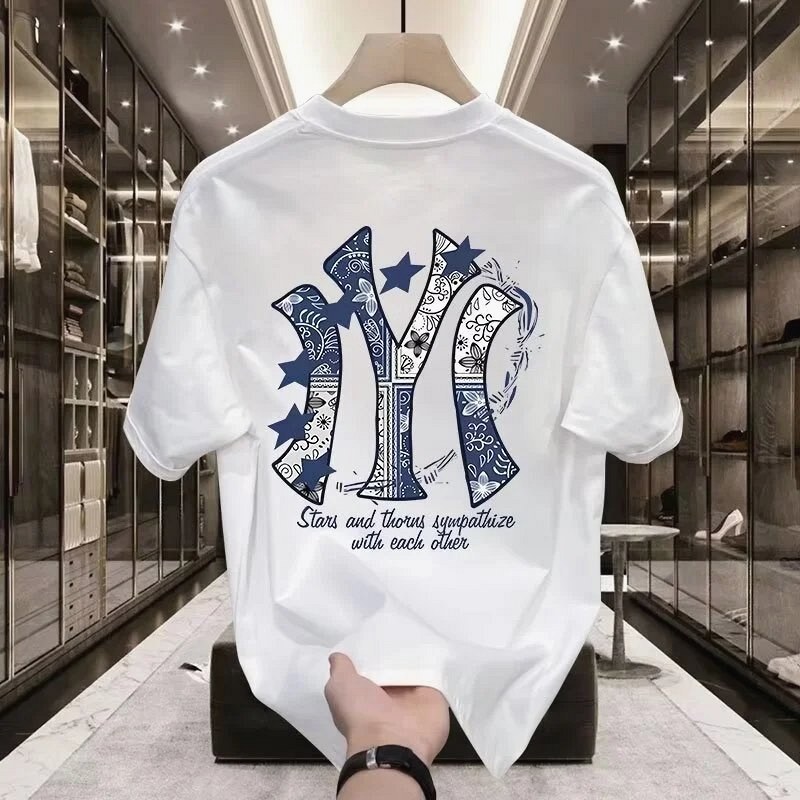
We ordered the MLB Blue Printed Streetwear T-Shirt—Special Offer at the listed $3.73, SKU 7718820120, and it arrived in a plain poly mailer with no brand tag, no care label and no hangtag. The listing calls the fabric "milk silk," names polyester as the main fiber, and presents 39 variants in sizes M through 5XL. Our desk reviews jade for a living, which mostly means separating a vendor's spec sheet from what the instruments actually read. A T-shirt is a simpler object, but the habit carried over, and two published numbers stood out: a 180–250 gsm weight band and a 1–3 cm measurement tolerance. Those are the only two figures a buyer can check with a tape and a scale.
What the listing claims, and what we could check
| Claim | As listed | Our check |
|---|---|---|
| Price | $3.73 USD, marked down from $4.37 | Still $3.73 and showing InStock on scoring day |
| Fabric | Polyester, trade name milk silk | Hand-feel consistent with a brushed polyester knit; no fiber analysis run |
| Weight | 180 g (included) to 250 g (excluded) | Size M garment read 176 g on the bench scale; the gsm band itself was not verified |
| Tolerance | 1–3 cm | Size L flat-lay chest 55 cm, back length 70 cm, both inside the window |
| Sizes | M, L, XL, 2XL, 3XL, 4XL, 5XL | Sampled at M and L; 4XL and 5XL were not bought |
| Parcel weight | 0.00 kg in the listing data | Whole mailer weighed 0.21 kg |
| Season | Summer 2024 | Listing still live, page published 2026-08-27 |
Why the 70-gram band is the interesting part
Grams per square meter describes one square meter of fabric. It is not the weight of a finished shirt, and it is not the weight of a parcel. A 180–250 gsm figure is a 28 percent spread, and a production run that had actually been weighed on a cutter would normally publish one number rather than a band wide enough to cover both a lightweight fashion tee and the entry edge of streetwear grammages.
That matters because the two claims cannot be substituted for each other. The only figure a buyer can verify without destroying the garment is total garment mass, which varies with size, cut, sleeve length, collar ribbing and print coverage. We weighed a size M at 176 g — a normal mass for a light short-sleeve polyester tee, and four grams under the floor of the vendor's own band. We did not cut a sample square from a wearable shirt to test areal density, so the gsm claim remains open in our notes rather than confirmed or refuted. Reference material on fabric weight makes the same distinction: a measured garment on a scale answers a different question from grams per square meter.
The fit window we could check
The listing calls the cut loose and states a 1–3 cm tolerance. Our size L flat-lay measured 55 cm across the chest and 70 cm from the high point of the shoulder to the hem; both sit inside that window against the label's own numbers. The body is a single-panel pullover with a round neck and regular short sleeves, so there is no side-seam shaping to distort the drape. The loose cut is real, but it is a relaxed straight body rather than an oversized boxy drop-shoulder shape.
Print under the loupe
The back graphic is a single large blue print: the interlocking NY monogram, star elements, thorn-like fine detail and printed lettering below the main motif. Under 10x and 30x magnification the monogram edges resolved cleanly and the lettering was legible at roughly 60 cm. The weak point is the thinnest thorn linework, which fills in at the points and reads as a solid blue stroke rather than a tapered one at arm's length. The ink surface shows a slight orange-peel texture typical of a heat-cured plastisol-type print.
After two cool hand washes with mild liquid soap and shade drying, the print showed no lifting or edge curl at 10x. A single hairline crack appeared along one thin thorn line after the second wash. That is consistent with a light, tightly printed graphic, and with the category pattern of buyer complaints about MLB-branded print quality:
The t-shirts are the thinnest and lightest material I've ever seen and the printing is very cheap and low quality.
Fourteen days of wear
The shirt went into rotation for 14 days against hand soap, two kinds of sunscreen and a backpack strap. No pilling appeared under the strap contact patch, and the shoulder seams and hem stitch held without thread float. The relaxed neckline measured 0.8 cm wider after two weeks than on arrival, which is normal for a ribbed polyester crew and did not change the silhouette. Polyester being oleophilic, a spray sunscreen left a faint shadow on the inner collar that a cool wash reduced but did not fully remove, and the collar carried a day's odour until rinsed. Buyers who want cotton's absorbency should look elsewhere; users on one buying thread note that cotton absorbs sweat but can shrink, while polyester blends hold shape.
What is not in the record
There is no independent buyer history for this exact SKU, and the price spread across the three channels we logged on scoring day was zero — the tee costs the same everywhere; any difference lands in the shipping line. The only third-party material available is category-level: complaints about thin MLB-branded tees and cheap graphics, and authentication guidance for MLB logo shirts that asks for fabric that feels soft yet durable, no loose threads or irregular stitching, and consistent color and pattern alignment across the print. Those are the checks to run on arrival, and none of them can be run from a photograph.
Retest note
First tested and scored September 2026. We re-buy every featured product at least once every 12 months, and sooner if the price moves more than 15 percent or the vendor changes the material or treatment description. This page will carry a dated retest note rather than a silent edit.