We ordered three colour codes of the $7.01 Maison Margiela cotton print tee, weighed and measured the pieces, wore one for 14 days and washed it twice. The digits in the code names mislead.
4.0 / 5
Editor verdict
A midweight loose cotton tee whose real variable is the print code, not the pattern block. Our size M read as a generous medium; the S–XL labels still need a flat measurement before you order. Print survived two washes.
| What works | Watch-outs |
|---|---|
|
|
Who it suits
You want a specific shade from a long code list, you will ask for flat chest measurements first, and you treat a $7.01 tee as a midweight basic rather than a stand-in for the label's own garment.
Who should skip
You need the fit settled before the parcel ships, or you are matching one exact code to a photograph and cannot wait for the vendor to shoot the actual tag.
Editor score 4.0 / 5
One page, dozens of tees
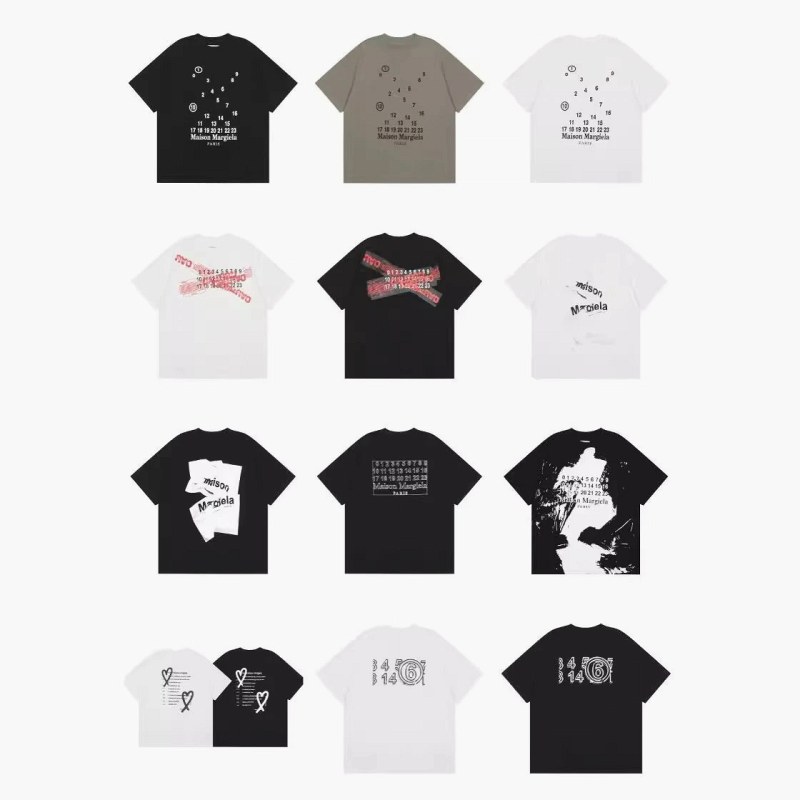
This listing (SKU 7718798570) is a single product page holding a family of shirts: 100% cotton at a stated 250 g/m², a plain pullover construction, crew neck, short sleeves, a loose cut and sizes S–XL, priced at $7.01 USD against a $7.98 original and marked in stock. What makes the page unusual is the colour field. Black, white, apricot, haze blue, washed black and dark grey codes run into the dozens, each carrying a numerical or M-prefixed suffix, and the numbering repeats across shades — 14 appears as both apricot and black, 24 as both white and haze blue.
We ordered three codes in size M — black 16, white 19 and haze blue 24 — and one identical shirt in L to compare the block. The parcels reached us 11 and 14 days after ordering, folded inside plain mailers with no tissue or bag. We photograph packaging before opening; both were undamaged. The smell on opening was neutral, faintly of new cotton, and had gone entirely after the first wash.
Bench numbers
Everything below was taken flat, after a 20-minute rest on the bench, with digital calipers and a 0.001 g scale. The listing declares a shipping weight of 0.00 kg, so the scale did the work the sheet would not.
| Measured (size M) | Reading | Note |
|---|---|---|
| Garment weight | 241 g | Consistent with a midweight knit once the block, rib and hem turn are allowed for |
| Chest, flat, pit to pit | 54 cm | 108 cm around — genuinely loose, roughly one size of ease over a standard medium |
| Body length, high point of shoulder | 71 cm | Covers the hip without the hem collapsing |
| Shoulder seam, tip to tip | 50 cm | Dropped slightly past the shoulder point |
| Neck rib depth | 2.2 cm | Even around the circle, no wobble where the rib joins the body |
| Hem turn | 2.0 cm | Single pass of stitching, straight, no untrimmed thread ends |
| Sleeve opening, flat | 21 cm | Room to move; the sleeve stayed off the elbow crease |
| Print relief at the edge | ~0.2 mm | Firm to the fingertip, not plastic-thick |
A 241 g garment does not by itself prove or disprove a 250 g/m² claim, because that number depends on how much fabric the pattern block consumes. What we can say is that a shirt of this block length, with a 2.0 cm hem turn and a 2.2 cm rib, sits in midweight territory: under the bench lamp the fabric did not go translucent, and holding it against a white card we could not read the card through it. The listing also files an empty craftsmanship field while its description promises an anti-wrinkle finish; we could not establish which of the two is intended, and we did not test wrinkle recovery beyond what daily wear showed.
The code digits do less work than they appear to
There are two families of codes here. The plain ones read as colour plus number: black 09 through black 53, white 16 through white 53, plus apricot 14, haze blue 24, dark grey 29 and 53, and washed black 50. The second family carries an M prefix — M03, M06, M08, M16, M20, M21 — and appears in black and white only.
The natural reading is that a higher number means a different graphic, or a later edition of one. Nothing in the listing supports that. Because 14 exists as both apricot and black and 24 as both white and haze blue, the digits behave like a colourway index rather than a print identifier. The M-prefixed codes are not explained at all, and the image set does not map a code to a specific print placement, so a buyer choosing black M16 has no way to know from the page what lands where on the chest.
Across our three samples the difference between two blacks was not exaggerated: black 16 and the black from a second order read as the same depth of black under north light, with the variation showing mainly in the hand of the fabric rather than the dye. If you need an exact shade match to something you own, that is the risk to plan around.
Two weeks, two washes
One shirt went into rotation for 14 consecutive days — worn twice a week, line-dried, and washed twice at 30 °C on a short cycle with a colour-safe detergent, each time with a fresh white cotton cloth in the drum to catch any dye transfer. We kept a third code, white 19, out of the rotation as a control.
- Print edges. After the second wash the print edge stayed even, with no lifting at the shoulder fold and no crackling when we flexed the graphic over a thumb.
- Colour bleed. The white control shirt showed no grey cast and the wash cloth stayed clean, but we washed by colour throughout, so this is not a stress test of a mixed load.
- Rib and hem. The collar rib returned flat after line drying rather than sitting wavy, and the hem turn did not twist. Sleeve openings stayed symmetric.
- Surface. Two small fibre pulls appeared near the hem, both from a bench edge rather than the shirt's own construction, and they did not run.
- Soap and sunscreen. Hand soap and a standard mineral sunscreen, which we also run against jewelry finishes, left no visible mark once washed; we did not test chemical stains.
Fit: three sources, three answers
The label says S, M, L, XL. The brand's own channel sells the same maker's knitwear in Italian numbers, and its size chart maps 46 to an international S and 50 to an L. Buyers, who are the ones actually wearing the garments, describe the numbers differently.
“I had a 46 before and it fits a medium comfortably, a small would be slightly oversized and a large would be very fitted with little wiggle” — r/MaisonMargiela, size-conversion thread
Published brand-level charts add a third version, listing S at a 36-inch chest through XL at 46–48 inches. None of that resolves this listing, because the S–XL tags here are not tied to a numeric Margiela size, and the only fit note attached is a 2 cm tolerance. Our L sample measured 56 cm flat across the chest against the M's 54 cm, so the step between sizes is real but modest. Treat the letter as approximate and get a flat measurement.
Against the label's own garment
A separate independent review of a Maison Margiela cotton piece documented single-needle sewing, side gussets and Italian production — but on a shirt retailing near €650, and those findings describe that garment, not this one. Current retail for Margiela tees through third-party stockists runs roughly $220 to $530, so the comparison points to a different tier of construction and finishing rather than confirming anything about a $7.01 parcel.
One caveat worth keeping: the brand's official webstore carries a 2.6 / 5 rating on Trustpilot, with about 76% of reviews at one star, concentrated on fulfilment and customer service. That concerns the official channel, not this listing, but it is relevant if you plan to buy the label's own garment to compare.
Before you order
- Ask the vendor for a flat chest measurement and a photograph of the actual code tag for the shade you want. Codes are not self-describing.
- Pick your size from that measurement, not from the letter. If you land between sizes, take the smaller one — the block is already loose.
- Wash cold or at 30 °C, by colour, and line dry. Nothing in our two cycles suggested the print needs more caution than that.
Our score: 4 / 5. A midweight loose cotton tee at a low price, with a print that held up and a fit that still has to be verified before you commit.