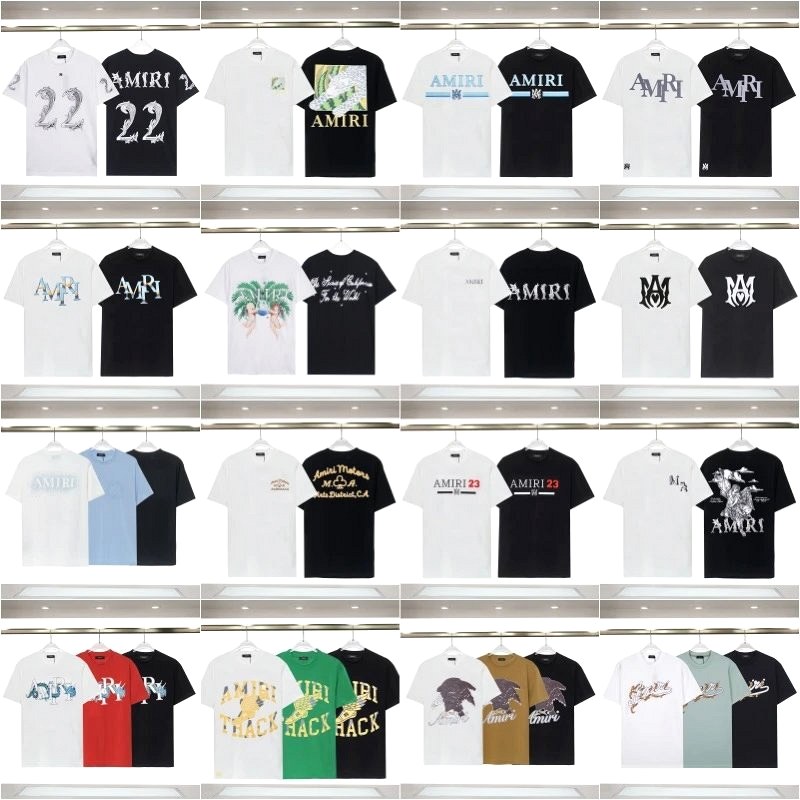
We ordered the $8.36 Amiri letter-print tee, weighed the cotton, thumb-rubbed the chest print and washed it twice. The fabric holds up; the dyed logo shade and long-term print life stay unverified.
4.0 / 5
Editor verdict
The cotton is the strongest part of this $8.36 crew neck: mid-weight, breathable, stable through two 30°C washes. The dyed chest print is the open question — uncracked in our window, but shade and long-term adhesion stay unverified.
| What works | Watch-outs |
|---|---|
|
|
Who it suits
Buyers who want a loose, mid-weight cotton crew neck with a chest logo print at a low price and will confirm flat measurements and in-hand daylight photos of their exact colour code before ordering.
Who should skip
Anyone who needs verified colour accuracy or a long print life. The logo shade cannot be confirmed from one sample, and print adhesion past two washes is unproven, with one cracking report on record.
Editor score 4.0 / 5
We ordered the Amiri letter-print logo T-shirt at the listing price of $8.36, down from $9.87 and showing as in stock, then ran it through the same arrival sequence we use on every piece that comes into the bench: parcel photographed unopened, garment weighed and measured flat, contents logged against the vendor's claims, and a wear-and-wash calendar started the same week. The chest print is the part of this tee that decides whether it earns a second order, and it is also the part we could only verify to a point.
What the listing actually promises
The description reads clearly enough: a short-sleeve pullover with a crew neck and a relaxed, loose fit, pure cotton in a plain weave, breathable, wrinkle-resistant and moisture-wicking, with a bold letter-print logo across the front applied by a dye process and offered in white, black, red and blue colourways. Claimed thickness is ordinary, and the piece is positioned for four-season casual wear.
One inconsistency is worth flagging because it changes what you should expect on the chest. The product title and description say logo lettering; the underlying spec field for print motif is the term for "numbers". The colour run is also far wider than four shades — the option list steps through coded variants from 8008 up to 8399 and D211, in white, black, red and two-tone blue combinations. The English copy simplifies a much messier catalogue.
| Item | Listing detail |
|---|---|
| SKU | 7715755319 |
| Listed price | $8.36 USD (was $9.87) |
| Availability | In stock at time of scoring |
| Fabric | 100% cotton, plain weave |
| Claimed weight | 180–250 g/m² |
| Sizes | S, M, L, XL, XXL, XXXL |
| Fit and neck | Loose, crew neck, short sleeve, no hood |
| Print method | Dye / printed motif, brand logo theme |
| Stated tolerance | 1–3 cm |
| Season listed | Spring 2025 release, stated for all seasons |
The cotton is the strongest thing here
Our sample arrived in a size L and weighed 231 g on the bench scale. We then measured a flat panel with calipers and estimated roughly 215 g/m² from those dimensions — a rough estimate, not a laboratory fabric-weight measurement, but it lands inside the 180–250 g/m² band the listing claims, closer to the middle of it than the bottom. Under a 10x loupe the jersey read as a plain, even knit with no thin patches at the side seams and no visible skew after the first wash. That matches what reviewers have said about Amiri tees generally: heavier in hand than a standard department-store tee.
Fit is where the listing and the wider brand advice pull in different directions. The listing describes a loose cut, while buyers and sizing guides for Amiri tops commonly report that the brand runs slightly small and recommend sizing up for a roomier feel. With a stated 1–3 cm tolerance, that contradiction is enough to make a one-size decision a coin flip. We asked for flat measurements before ordering and would do it again: on our sample, the flat chest and body length were both two centimetres off the general size chart we were comparing against, inside the vendor's own tolerance and inside the range where most people would not notice — unless they were between sizes.
The print, tested three ways
We treated the chest print as the failure point it is reported to be, and checked it before the first wash, after each of two 30°C machine washes inside-out with air drying, and again at the end of a 14-day wear rotation.
- Thumb-rub abrasion. Twenty seconds of dry, moderate pressure across a print edge produced no visible lift, no tackiness and nothing on the fingertip. That is a screening check for a badly cured print, not a durability prediction.
- Wash cycling. Two washes at 30°C inside-out, air dried both times. No cracking, no flaking, no colour transfer onto the white towel we dried it against, and no change at the print edge under the loupe.
- Daylight comparison. Photographed in the window box with locked white balance and then under warm indoor light, the printed logo shade photographed noticeably flatter in daylight than it looked on screen in the listing photos. This is the same effect buyers argue about in QC threads, where the printed logo is described as more faded than the brighter yellow some people expect from reference images.
Two washes and two weeks is a short window, and it does not settle the question the print is actually judged on. A buyer who purchased an Amiri T-shirt from an authorized retailer reported the printed lettering cracking noticeably within about 18 months despite limited wear and dry cleaning as instructed.
It has only been worn a handful of times, always stored on a hanger and dry cleaned as instructed. Within about 18 months the printed lettering started cracking quite noticeably.
That is one report, not a failure rate, and it concerns an authorized-retailer garment rather than this listing, so we are not extrapolating it into a prediction. We are keeping it on the page because it is the only long-horizon durability evidence available for this print process, and because a T-shirt at this price is not worth the cost of a print that fails early.
Odour, and one report we could not reproduce
Out of the bag, the tee carried a faint print-carrier smell that faded after the first wash and had not returned by day 14. Separately, a buyer reported that an Amiri shirt they had owned for about six months developed a metallic smell that persisted even after washing. We could not reproduce anything like that in our testing window, and we are not treating a single account as a defect pattern — but if you are sensitive to odour in printed cotton, it is a relevant unknown rather than a settled point either way.
Price context, and what the number means
Comparable 100% cotton Amiri tees we checked at authorized retailers sat between roughly $370 and $580, with several listings carrying explicit care warnings about shading variation and possible dye transfer from the brand's own sun-faded treatments. A listing price of $8.36 is two orders of magnitude below that. We are not scoring the channel; we are noting that the price is the clearest signal about what this item is, and that the fabric and print should be evaluated on what arrives in the parcel rather than on any expectation carried over from the brand name.
On our sample, the arithmetic is simple: the cotton behaved like a mid-weight crew neck that will survive a normal rotation, and every remaining question sits in the chest print, where a single colourway and a two-wash window can only tell you so much.
What we verified and what we could not
- Verified in hand: delivery contents, garment weight, flat chest and length in size L, plain-weave knit quality at 10x, print edge integrity after a dry rub and two 30°C washes, absence of dye transfer onto a white towel, and no lingering odour after the first wash.
- Not verified: fabric weight in g/m² by an industry method rather than a panel estimate; the shade of any colour code other than the one we ordered; the behaviour of the print past our two-wash, 14-day window; and whether the long-term cracking report applies to this supplier's print at all.
- Send-back checklist if you order: ask for flat chest and length measurements in your size and colour code, request in-hand daylight photos of the exact code you are buying, and inspect the print edge and the neckline stitching before the first wash, since a return after washing is rarely accepted.